

CMMI (Capability Maturity Model Integration)
In the rush to deploy AI and robotics, many manufacturers skip the boring part: process stability and data governance. The result is “chaos at scale” – algorithms trained on bad data making bad decisions faster than ever. The Capability Maturity Model Integration (CMMI) methodology is the antidote to this chaos. While less “flashy” than SIRI or ADMA, CMMI provides the bedrock of discipline required to sustain any digital initiative. Without the process maturity that CMMI measures, advanced technology is often just a house of cards built on a shaky foundation.
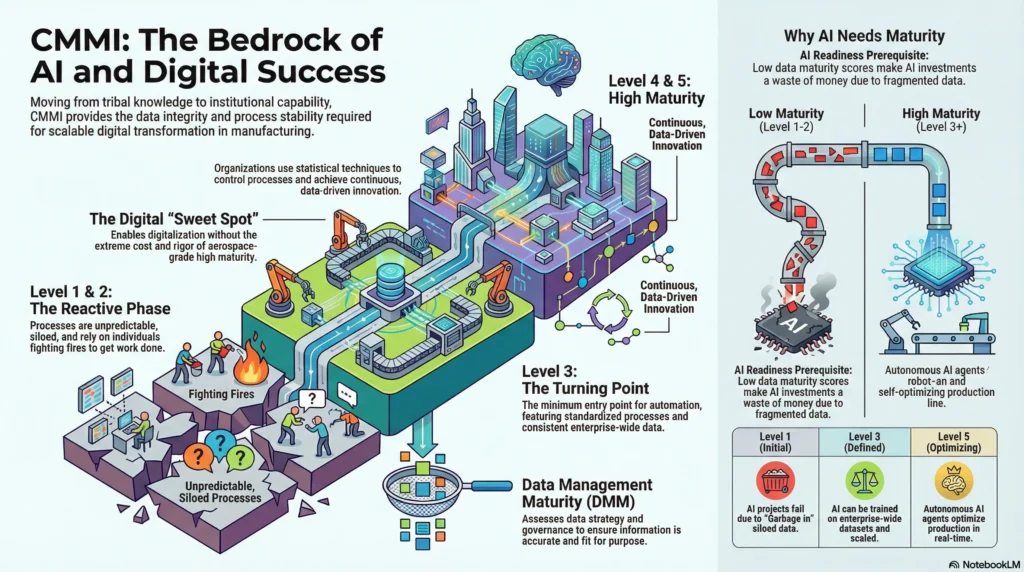
Figure 1: No AI without Data Integrity. Before automating, manufacturers must leave the “Reactive Phase.” The CMMI framework ensures you aren’t just automating chaos, preventing the “Garbage In” scenario for your AI models.
What is CMMI? From Software to Manufacturing Excellence
Born in the rigorous world of defense software engineering (SEI/Carnegie Mellon), CMMI has evolved into a universal framework for business performance. The release of CMMI V2.0 and subsequently V3.0 (2023) marked a pivot toward hardware, services, and data management.23
CMMI views digital maturity through the lens of “Capability.” It asks: Do you have a standard way of doing things? Is it documented? Is it measured? Is it improving? In a manufacturing context, this means moving from “tribal knowledge” (where only Old Joe knows how to fix the machine) to “institutional capability” (where the process is robust regardless of who is on shift).25
The 5 Levels of Maturity: The Path to Predictability
CMMI’s iconic 1-5 scale is the industry standard for describing process health.26
- Level 1 (Initial): The “Hero Mode.” Processes are unpredictable and reactive. Work gets done because individuals stay late and fight fires. There is no digital consistency.
- Level 2 (Managed): Projects are planned and managed, but processes vary between departments. The “Maintenance” team might be digital, but “Logistics” is on paper.
- Level 3 (Defined): The Turning Point. The organization has standard processes. Data definitions are consistent across the enterprise. This is the minimum entry point for effective wide-scale automation.
- Level 4 (Quantitatively Managed): The organization uses statistical and quantitative techniques to control processes. You don’t just know that you missed a target; you know statistically why.
- Level 5 (Optimizing): Continuous improvement is baked into the DNA. The organization focuses on innovation and agility, using data to self-optimize.
CMMI Data Management Maturity (DMM): The Prerequisite for AI
The most critical contribution of CMMI to the current digital landscape is the Data Management Maturity (DMM) framework. As factories become data-driven, data becomes a strategic asset. CMMI DMM assesses the health of this asset across six categories27:
- Data Strategy: Is data treated as capital?
- Data Governance: Who is accountable for data quality?
- Data Quality: Is data “fit for purpose” (accurate, timely)?
- Data Operations: How is data managed through its lifecycle?
- Platform & Architecture: Integration and security.
- Supporting Processes: Compliance and standards.
If a manufacturer scores low on DMM, investing in AI is a waste of money. The algorithms will fail because the underlying data is fragmented or dirty. CMMI provides the “data hygiene” roadmap.28
Hidden Costs and “Bureaucracy”
CMMI has a reputation for being heavy.
- The Documentation Burden: Achieving Level 3 or higher requires significant documentation. Critics argue this stifles agility (“we spend more time documenting the work than doing it”). However, V2.0 and V3.0 have streamlined this to focus more on “practice” than “paperwork”.25
- Cost of Appraisal: A formal SCAMPI appraisal is an expensive, multi-week rigor involving external lead appraisers. It is often only justifiable for large enterprises or those bidding for government/defense contracts where it is mandatory.30
- Cultural Resistance: Implementing CMMI requires a culture of discipline. In environments used to “cowboy coding” or “firefighting,” this shift can cause significant friction.31
Table: Why AI Needs CMMI Levels
| CMMI Level | State of Data & Process | AI/Digital Consequence |
| Level 1 | Ad hoc, siloed data. | AI projects fail due to lack of training data. “Garbage In.” |
| Level 2 | Project-specific data pools. | AI works in pilots but fails to scale across the factory. |
| Level 3 | Standardized data definitions. | AI can finally be trained on enterprise-wide datasets. Scalability achieved. |
| Level 4 | Statistical process control. | Predictive Maintenance (AI) becomes highly accurate due to stable baselines. |
| Level 5 | Continuous optimization. | Autonomous AI agents optimize production in real-time. |
Digital maturity check
Where does your plant stand?
Before you invest in AI, find out which maturity gaps to close first. Check your plant’s digital maturity in Consultify, free.
FAQ: CMMI in the Factory
No. CMMI V2.0 and V3.0 were explicitly designed to work with Agile and DevOps. It provides the governance wrapper that Agile often lacks, ensuring that “moving fast” doesn’t mean “breaking things” permanently.32
No. For most manufacturers, Level 3 is the sweet spot. It provides enough standardization to enable digitalization without the extreme cost of Level 4/5 statistical rigor, which is reserved for high-stakes environments (e.g., aerospace safety).26
Yes. You can pursue a targeted CMMI DMM assessment without appraising your entire engineering or service organization. This is a common starting point for digital transformation.33
Conclusion: The Bedrock of Digital Success
CMMI is not the most exciting acronym in Industry 4.0, but it is the most necessary for long-term stability. If your digital transformation feels like it is constantly putting out fires, or if your data scientists spend 80% of their time cleaning spreadsheets, you need CMMI. It builds the “process muscles” that allow an organization to carry the heavy weight of advanced technology without collapsing.
Before buying your next expensive software platform, conduct a lightweight CMMI Data Management Maturity assessment. Fix your data governance first; buy the AI second.
Would you like to learn about other assessment methodologies? – see the comparison of digital maturity assessment methods – or read about each method separately:
Author: Tomasz Jankowski

R&D Specialist at DBR77, focusing on IT development, Digital Twin technology, and automation. He has a strong background in managing EU projects and conducting research work. A graduate of Nicolaus Copernicus University in Toruń, he combines scientific precision with the implementation of technological innovations.
Digital maturity check
Turn CMMI into a plan
Get a maturity snapshot of your processes and data, with a prioritized list of next steps for your plant.
Cited works
23. GovCon Expert Ron Lear on the Business-Minded Updates of CMMI v3.0, GovconwireGovCon Expert Ron Lear on the Business-Minded Updates of CMMI v3.0
24. Capability Maturity Model Integration – Wikipedia, WikipediaCapability Maturity Model Integration – Wikipedia
25. What is CMMI 2.0? Requirements, maturity levels and appraisal methods – Spyrosoft, Spyro-softWhat is CMMI 2.0? A guide to CMMI requirements, maturity levels and appraisal methods
26. CMMI Levels of Capability and Performance, otwierano: stycznia 21, 2026, CmmiinstituteCMMI Institute – CMMI Levels of Capability and Performance
27. Data Management Maturity Model—Process Dimensions and Capabilities to Leverage Data-Driven Organizations Towards Industry 5.0 – MDPI, Mdpimdpi.com/2571-5577/8/2/41
28. What is Data Management Maturity? – Actian Corporation, ActianWhat is Data Management Maturity?
29. An Exploratory Study of Why Organizations Do Not Adopt CMMI – ResearchGate, Researchgateresearchgate.net/publication/222669339_An_Exploratory_Study_of_Why_Organizations_Do_Not_Adopt_CMMI
30. Why CMMI is A Better Alternative for Manufacturing Than ISO 9001 – Oxebridge,
31. Challenges in Implementing CMMI High Maturity: Lessons Learned and Recommendations, Asqasq.org/quality-resources/articles/challenges-in-implementing-cmmi-high-maturity-lessons-learned-and-recommendations?id=4bed8e14dd734a43a18e8f69cb0475a5
32. The Future of CMMI Appraisal and Its Implications in 2024 – Sync Resource,
33. CMMI Data, CmmiinstituteCMMI Institute – CMMI Data