In the high-stakes world of global manufacturing, intuition is no longer enough. Decisions involving millions of dollars in CAPEX require rigorous, data-backed justification. Enter the Smart Industry Readiness Index (SIRI) – a framework that has transcended its origins to become the internationally recognized language of Industry 4.0. For CTOs and Plant Managers seeking a precise, engineer-grade evaluation of their facilities compared to global peers, SIRI offers unmatched granularity and objectivity.
What is SIRI and Why is it the “Technocrat’s Choice”?
SIRI was developed by the Singapore Economic Development Board (EDB) in collaboration with TÜV SÜD and major tech players, and it is endorsed by the World Economic Forum (WEF).13 This lineage is important: SIRI was built to be the “ISO standard” of digitalization.
Unlike ADMA, which focuses heavily on the “soft” aspects of culture and sustainability, SIRI is unapologetically technical and process-oriented. It breaks down the nebulous concept of “Smart Manufacturing” into a periodic table of tangible elements. If ADMA is the philosophy of transformation, SIRI is the engineering schematic. It is particularly powerful for multi-site corporations that need to compare the maturity of a plant in Germany with one in Vietnam using a standardized ruler.14
The LEAD Framework and the 3-8-16 Architecture
SIRI is built on a hierarchical structure that ensures no stone is left unturned. This is known as the LEAD framework (Learn, Evaluate, Architect, Deliver), but the core assessment relies on the “3-8-16” matrix.16
The 3 Building Blocks
SIRI posits that Industry 4.0 rests on three legs:
- Process: The integrity of operations and supply chains.
- Technology: The hardware and software infrastructure.
- Organization: The management structure and workforce readiness.
The 8 Pillars and 16 Dimensions
These blocks expand into 16 specific dimensions that are scored on bands from 0 (Bottom) to 5 (Future Ready).
- Under Process: SIRI evaluates Vertical Integration (does the machine talk to the ERP?) and Horizontal Integration (does the ERP talk to the supplier?). It also looks at Product Lifecycle Integration, assessing if design data flows seamlessly into production and maintenance.16
- Under Technology: This is SIRI’s stronghold. It subdivides technology into three layers: Shop Floor, Enterprise, and Facility.
- For each layer, it assesses Automation (robotics, CNC), Connectivity (IoT, 5G, interoperability), and Intelligence (AI, analytics). This granularity is crucial. A factory might have excellent Enterprise Intelligence (BI dashboards) but zero Shop Floor Connectivity (machines are air-gapped). SIRI exposes this disconnect immediately.17
- Under Organization: It assesses Talent Readiness and Structure & Management. It checks if the leadership has a clear digital strategy and if the workforce has the competence to execute it.16
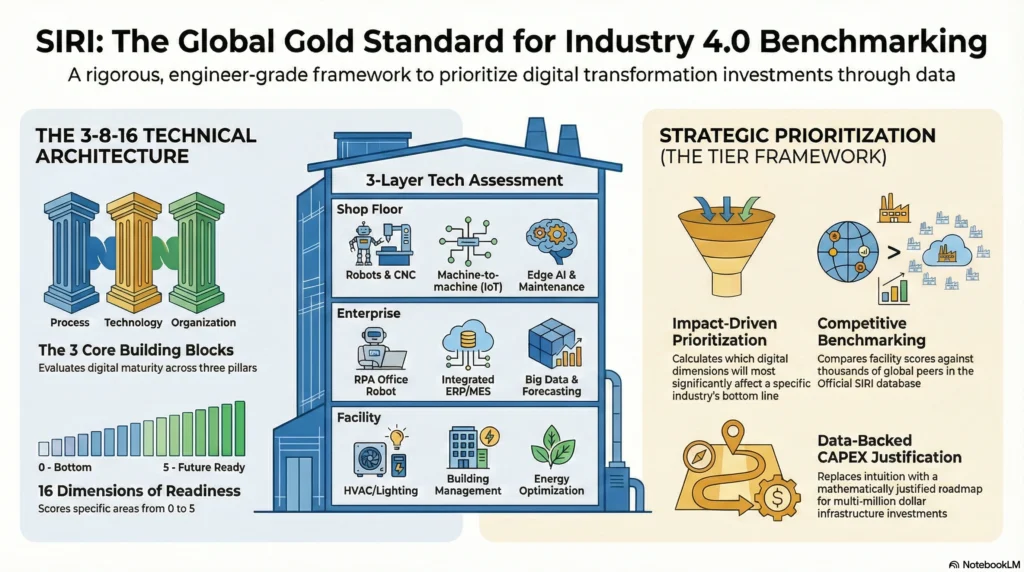
Figure 1: The Engineer’s Choice. SIRI moves digital transformation from “gut feeling” to data science, offering a rigorous framework to justify multi-million dollar CAPEX investments through global benchmarking.
The TIER Framework: Solving the “Where to Start?” Crisis
The most valuable output of a SIRI assessment is the Prioritization Matrix, derived from the TIER framework.18
- T (Today’s State): The current maturity score.
- I (Impact to Bottom Line): A calculated weighting of which dimensions impact costs and revenues most for your specific industry. For example, in Pharmaceuticals, “Quality” impact is high; in contract manufacturing, “Efficiency” is king.
- E (Essential Business Objectives): Alignment with the company’s specific strategic KPIs.
- R (References to Broader Community): This is the killer feature. SIRI compares your scores against thousands of other companies in the Official SIRI Assessment (OSA) database. It tells you: “You are in the top 10% for Connectivity, but the bottom 20% for Process Integration”.15
This matrix produces a clear, mathematically justified list of priority projects, eliminating internal politics about where to invest budget.
Hidden Challenges and Costs of SIRI
SIRI’s rigor comes at a price.
- Complexity and Cost: An Official SIRI Assessment (OSA) is not a DIY online quiz. It requires Certified SIRI Assessors (CSAs) and typically spans several days of workshops and site visits. The cost can be significant (thousands of dollars per site), making it a substantial commitment for smaller firms.19
- The “Band” Obsession: Companies sometimes fall into the trap of “chasing bands”—trying to move from Band 2 to Band 3 for the sake of the score, rather than for business value. A higher band in “Facility Automation” might not make financial sense for a low-volume workshop, yet the model might implicitly encourage it.21
- Technocentrism: While it includes an “Organization” block, critics argue SIRI is still heavily biased towards technical solutions. It might recommend an expensive MES system when a simple process change (Lean) would suffice.21
Table: The SIRI 3-Layer Technology Assessment
| Layer | Automation (Doing) | Connectivity (Talking) | Intelligence (Thinking) |
| Shop Floor | Robots, CNC, AGVs executing tasks. | Machines communicating via OPC-UA/MQTT. | Edge computing, predictive maintenance AI. |
| Enterprise | RPA (Robotic Process Automation) in office tasks. | ERP, MES, PLM systems integrated. | Big Data analytics, demand forecasting. |
| Facility | HVAC, Lighting, Security automation. | Building Management Systems (BMS). | Energy optimization algorithms. |
Insight: SIRI’s separation of “Facility” helps identify energy savings that other product-focused models miss.
FAQ: Is SIRI Right for You?
It might be overkill. The full OSA is designed for complex operations. For smaller firms, a simplified self-assessment or a lighter model like ADMA might be more cost-effective initially.15
Yes, completing an Official SIRI Assessment provides a recognized report and “band” rating, which can be valuable for proving capabilities to global customers or investors.22
SIRI assesses “Connectivity” and “Readiness,” but for a deep dive into Cyber Security, it is often paired with specific security audits (like IEC 62443 or CMMI Security) as SIRI’s primary focus is operational capability.23
The EDB and certified partners maintain a global database of anonymized assessments. This allows you to benchmark against “Best-in-Class” in your specific niche (e.g., “Semiconductor Manufacturers in Asia”).14
Conclusion: The Ruler for the Digital Age
SIRI is the “gold standard” ruler for digital maturity. It doesn’t tell you a story; it gives you the data. For organizations that need to make hard, expensive decisions about infrastructure and want to mitigate risk through rigorous benchmarking, SIRI is indispensable. It converts the vague ambition of “Industry 4.0” into a concrete, prioritized engineering roadmap.
Strategic Advice: Use SIRI when you need to justify a budget to a CFO. The argument “we are in the bottom quartile compared to our competitors” is a powerful catalyst for investment.
Author: Tomasz Jankowski, R&D Specialist, DBR77

R&D Specialist at DBR77, focusing on IT development, Digital Twin technology, and automation. He has a strong background in managing EU projects and conducting research work. A graduate of Nicolaus Copernicus University in Toruń, he combines scientific precision with the implementation of technological innovations.
Cited works
13. Smart Industry Readiness Index (SIRI) – TÜV SÜD, Tuvsudtuvsud.com/-/media/regions/us/pdf-files/infographics/tuvsud-smart-industry-readiness-index-siri-infographic.pdf
14. DBR77 Robotics, otwierano: stycznia 21, 2026, Dbr77DBR77 – DBR77 Robotics
15. The Global Smart Industry Readiness Index Initiative: Manufacturing Transformation Insights Report 2022 | World Economic Forum, Weforumwww3.weforum.org/docs/WEF_The_Global_Smart_Industry_Readiness_Index_Initiative_2022.pdf
16. THE PRIORITISATION MATRIX – Singapore EDB, Govedb.gov.sg/content/dam/edb-en/about-edb/media-releases/news/the-smart-industry-readiness-index/Smart-Industry-Readiness-Index-Prioritisation-Matrix-Whitepaper.pdf
17. Analyzing the Smart Industry Readiness Index in Adopting Industry 4.0 Technologies – MDPI, Mdpimdpi.com/2227-9717/13/10/3172
18. The Smart Industry Readiness Index Prioritisation Matrix – TÜV SÜD, Tuvsudtuvsud.com/-/jssmedia/global/pdf-files/whitepaper-report-e-books/smart-industry-readiness-index_prioritisation-matrix.pdf
19. What is introduction to Smart Industry Readiness Index (SIRI) training? – TÜV SÜD, Tuvsudtuvsud.com/en/services/training/introduction-to-smart-industry-readiness-index
20. Certified Smart Industry Readiness Index (SIRI) Assessor Programme – TÜV SÜD, Tuvsudtuvsud.com/en-ph/services/training/smart-industry-readiness-index-siri-assessor-training-and-certification
21. A Dynamic Assessment of Digital Maturity in Industrial SMEs: An Adaptive AHP-Based Digital Maturity Model (DMM)with Customizable Weighting and Multidimensional Classification (DAMA-AHP) – MDPI, 2026, Mdpimdpi.com/2227-7080/13/7/282
22. The Global Smart Industry Readiness Index Initiative: Manufacturing Transformation Insights Report 2025 – Heyzine, Heyzinecdnc.heyzine.com/files/uploaded/e1c7742b08b608375ad57571bc6d17499a9b369e-2.pdf
23. GovCon Expert Ron Lear on the Business-Minded Updates of CMMI v3.0, GovconwireGovCon Expert Ron Lear on the Business-Minded Updates of CMMI v3.0