
Lean 4.0
For decades, Lean Manufacturing has been the religion of production efficiency, preaching the elimination of waste (Muda) and the pursuit of continuous improvement (Kaizen). Industry 4.0 arrived with a promise of sensors and servers. For a long time, these two worlds clashed: Lean purists viewed technology as unnecessary complexity and cost, while Technologists viewed Lean as analog and outdated. Lean 4.0 is the reconciliation of these views. It is the understanding that Industry 4.0 is not a replacement for Lean, but its ultimate accelerator.
The Core Philosophy: “Lean Before Digitize”
The golden rule of Lean 4.0 is simple: Do not automate a bad process. If you automate a process that produces defects, you simply produce defects faster. Lean 4.0 dictates that you must first streamline the process using Lean principles (Value, Flow, Pull), and then apply digital tools to overcome the physical limitations of analog Lean.1
How Digital Tools Supercharge Lean
Lean 4.0 doesn’t invent new goals; it uses new means to achieve old goals.
1. From Kanban to e-Kanban (Just-in-Time)
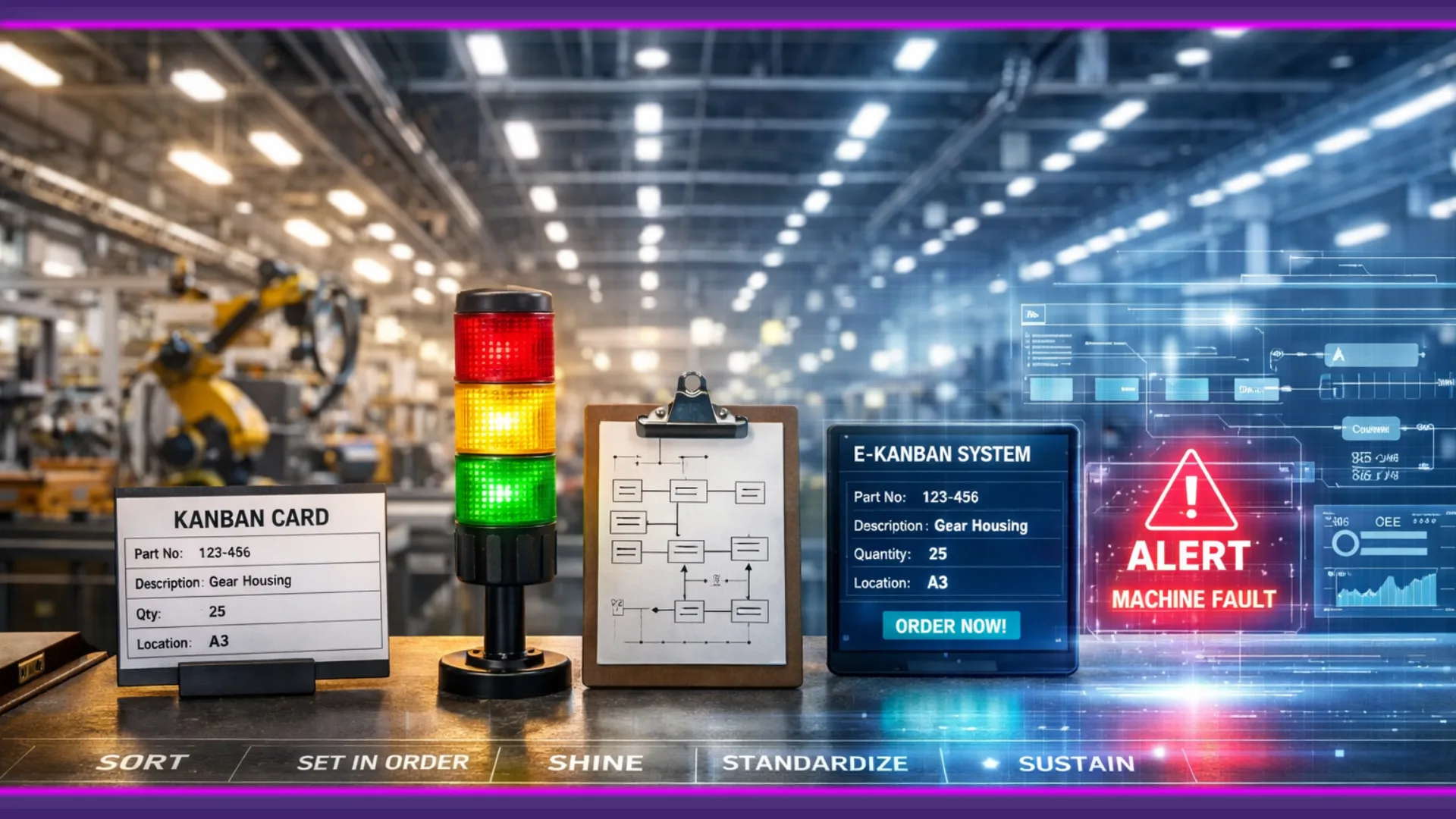
Traditional Kanban uses physical cards to signal the need for materials. It relies on human discipline and physical movement. e-Kanban uses RFID tags, weight sensors, or barcode scans to trigger replenishment signals automatically in the ERP/WMS.
- Benefit: Eliminates lost cards, reduces latency, and allows for dynamic adjustment of batch sizes based on real-time demand, not just historical averages.
2. From Andon Lights to Smart Alerts (Jidoka)
A physical Andon light on a machine tells you it has stopped – but only if you are looking at it. Digital Andon sends a push notification to the maintenance engineer’s smartwatch, specifying exactly what the error code is.
- Benefit: Drastically reduces Mean Time To Repair (MTTR) and allows for data logging of downtime reasons for Pareto analysis.2
3. From Paper VSM to Process Mining (Value Stream)
Value Stream Mapping (VSM) usually involves sticky notes on a wall. It represents a “snapshot” of how we think the process works. Digital VSM (using Process Mining software) uses the digital footprints of orders in the IT system to map the actual flow in real-time, highlighting bottlenecks, rework loops, and delays that humans ignore.
- Benefit: Moves from static, subjective maps to dynamic, objective flow analysis.26
4. Digital Poka-Yoke (Zero Defects)
Poka-Yoke means “mistake-proofing.” Physical jigs prevent a part from being inserted backward. Digital Poka-Yoke uses computer vision cameras or smart torque tools. The tool won’t activate unless the vision system confirms the correct part is in place.
- Benefit: Flexible mistake-proofing that can adapt to different product variants via software updates rather than expensive re-tooling.3
Hidden Traps in Lean 4.0
- The “Shiny Object” Syndrome: It is easy to get distracted by cool tech (AR glasses, drones) that doesn’t solve a real problem. Lean 4.0 requires strict discipline: “What waste does this eliminate?”.4
- Over-complicating Simple Solutions: Sometimes, a piece of tape on the floor is better than a $5,000 location sensor. Lean 4.0 assessments must always ask: “Is the analog solution sufficient?”.2
- Data Overload: Sensors can generate terabytes of data. If this doesn’t lead to actionable insights (Kaizen), the data storage itself becomes a form of digital waste.5
Table: Analog Lean vs. Lean 4.0
| Lean Tool | Analog Implementation | Lean 4.0 Implementation | Improvement |
| Kanban | Physical cards | RFID / Auto-replenishment | Speed, Accuracy, Dynamic Sizing |
| Andon | Light tower | Smartwatch alert / SMS | Response time, Data logging |
| Gemba | Walking with clipboard | Tablet with AR overlay | Data integration, Instant reporting |
| Poka-Yoke | Physical jig/fixture | Computer Vision / Smart Tool | Flexibility for product variants |
| TPM | Scheduled maintenance | Predictive maintenance (IoT) | Zero unplanned downtime |
FAQ: Implementing Lean 4.0
You need a solid understanding of Lean basics. If your factory is disorganized (no 5S), putting sensors on piles of junk won’t help. Start with basic housekeeping and standard work before adding sensors.6
It can be surprisingly cheap. Simple IoT buttons or retrofitted sensors on legacy machines cost very little compared to buying new machinery. It focuses on “retrofitting intelligence”.7
No. It gives them better tools. Instead of spending hours collecting data with a stopwatch, they spend their time analyzing the data and solving problems.4
Conclusion: The Pragmatic Path
Lean 4.0 is the most pragmatic entry point for digital transformation. It speaks the language of the shop floor—waste, flow, value. It doesn’t require a massive “Big Bang” implementation; it thrives on small, incremental digital experiments that pay for themselves.
Actionable Advice: Pick your biggest bottleneck. Ask: “How can digital data help me see this problem clearer or solve it faster?” That is your first Lean 4.0 project.
Would you like to learn about other assessment methodologies? – Read about each method separately:
Author: Tomasz Jankowski

R&D Specialist at DBR77, focusing on IT development, Digital Twin technology, and automation. He has a strong background in managing EU projects and conducting research work. A graduate of Nicolaus Copernicus University in Toruń, he combines scientific precision with the implementation of technological innovations.
Cited works
1. Lean manufacturing 4.0: what are the impacts? – Mercateam, MercaLean manufacturing 4.0: what are the impacts?
2. Waste reduction possibilities for manufacturing systems in the industry 4.0 – ResearchGate, Researchgateresearchgate.net/publication/311307586_Waste_reduction_possibilities_for_manufacturing_systems_in_the_industry_40
3. Lean Manufacturing in Industry 4.0: A Smart and Sustainable Manufacturing System – Semantic Scholar, Semanticscholarpdfs.semanticscholar.org/22bf/4d06fc1b78f90584b2ef9bf641e71a8be264.pdf
4. How Industry 4.0 is Transforming Lean Manufacturing – Tulip Co, TulipHow Industry 4.0 is Transforming Lean Manufacturing
5. Lean and Industry 4.0 – AllAboutLean.com, AllaboutleanLean and Industry 4.0 – AllAboutLean.com
6. Lean Manufacturing in Industry 4.0: A Smart and Sustainable Manufacturing System – MDPI, Mdpimdpi.com/2075-1702/11/1/72
7. Lean and Industry 4.0: Mapping determinants and barriers from a social, environmental, and operational perspective – ePrints Soton, Aceprints.soton.ac.uk/478563/1/Industry_4.pdf